Keeping Culture strong on Country: The passing down of Taungurung Knowledge
On Taungurung Country, the making of cultural artefacts is much more than a skill — it is a way of reading, listening to, and caring for Country. The knowledge of how to gather and shape resources like daanaks (coolamons) and shields has been passed down through generations, taught by Elders and role models, and practiced with respect for the trees, waters, and seasons that sustain us.
My name is Ben Young, and recently, I had the privilege of learning to cut a daanak from Ashley, a cultural role model, and Uncle Shane, a respected Taungurung Elder. Both shared their own techniques for making the daanak — a skill that begins not with tools, but with observation. You must look carefully at each individual tree, and its place in the landscape, to know if it is ready to give. In wetter times of year, more options appear; in dry times, the choices are fewer, reminding us that timing and patience are part of cultural practice.
In the Nagambie region, where the water brings extra moisture to the trees, we cut scars from the South-Eastern side — protecting them from the harsh afternoon sun. Not every tree is suitable. The bark must offer a smooth and even surface, and only those ready to share their strength can be chosen.
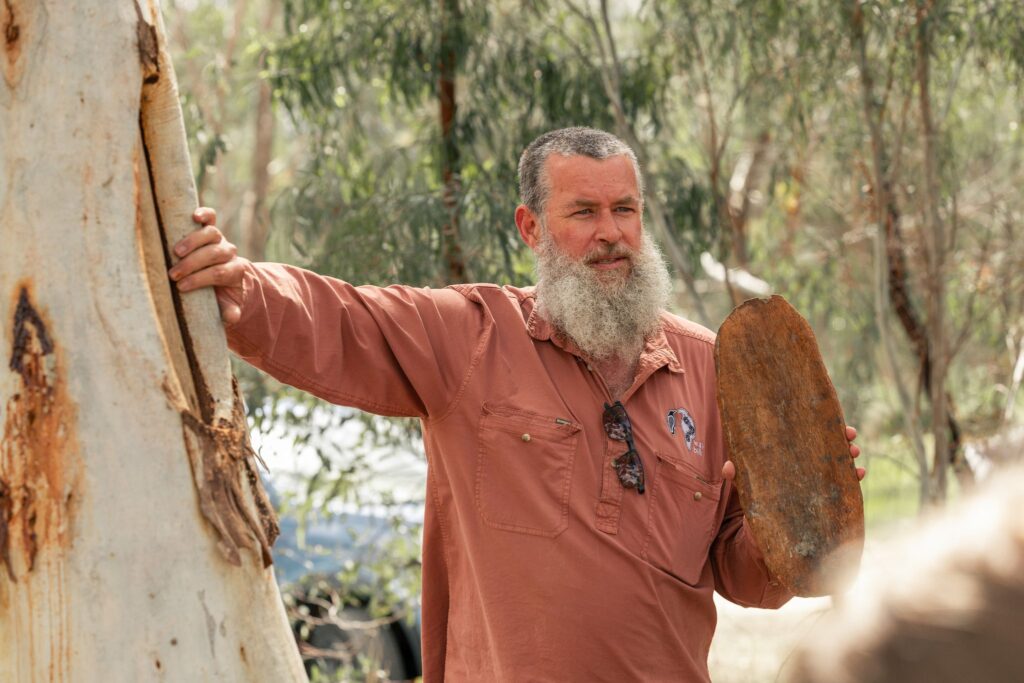
From this work, we gathered daanaks and a shield. Daanaks, also known as coolamons, are shallow vessels shaped and dried to the perfect curve. They become both practical and symbolic — used for gathering and serving food, but also carrying stories of Country. The shield we cut was shaped like an elongated daanak. To finish it, holes will be carved in the centre and a blackwood branch bent to form the handle — creating a strong, ceremonial tool.
These practices are guided not only by contemporary agreements, like the Recognition and Settlement Agreement (RSA) and Land Use Activity Agreement (LUAA), which give Taungurung People rights to gather resources on Crown Land, but also by our own Lore. That Lore tells us to never take more than we need, to harvest carefully, and to stop if Country is not healthy enough to give. It reminds us that cultural practice is inseparable from caring for Country.
Making artefacts on Country is therefore not simply about creating an object. It is about relationships — with Elders and knowledge-holders who pass down skills, with the trees and waters that provide resources, and with the broader community who continue to carry and honour Taungurung Culture. Each daanak, each shield, carries with it the story of the land it came from, and the responsibility to walk gently with Country for generations to come.
Ashley shared his reflection from the day also:
“As a young generation of the Taungurung nation I am very privileged and aware of the cultural roles and responsibilities that I hold! And having days out on country like the Daanak day are very special to me. It provides opportunity to practice our culture and strengthen it. It gives me a personal role to help the younger generations below me to come up strong and teach and show them the same culture that I was taught from our older generations and Elders. To give more mob the confidence to get out on Country and live their culture as we have the right to do so.” Ashley Wilkinson
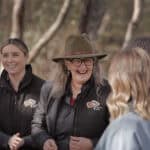
Information and reflections shared by Ben Young and Ashley Wilkinson – wawa biik Cultural Guides. Images of Ben and Ashley cutting their daanaks.